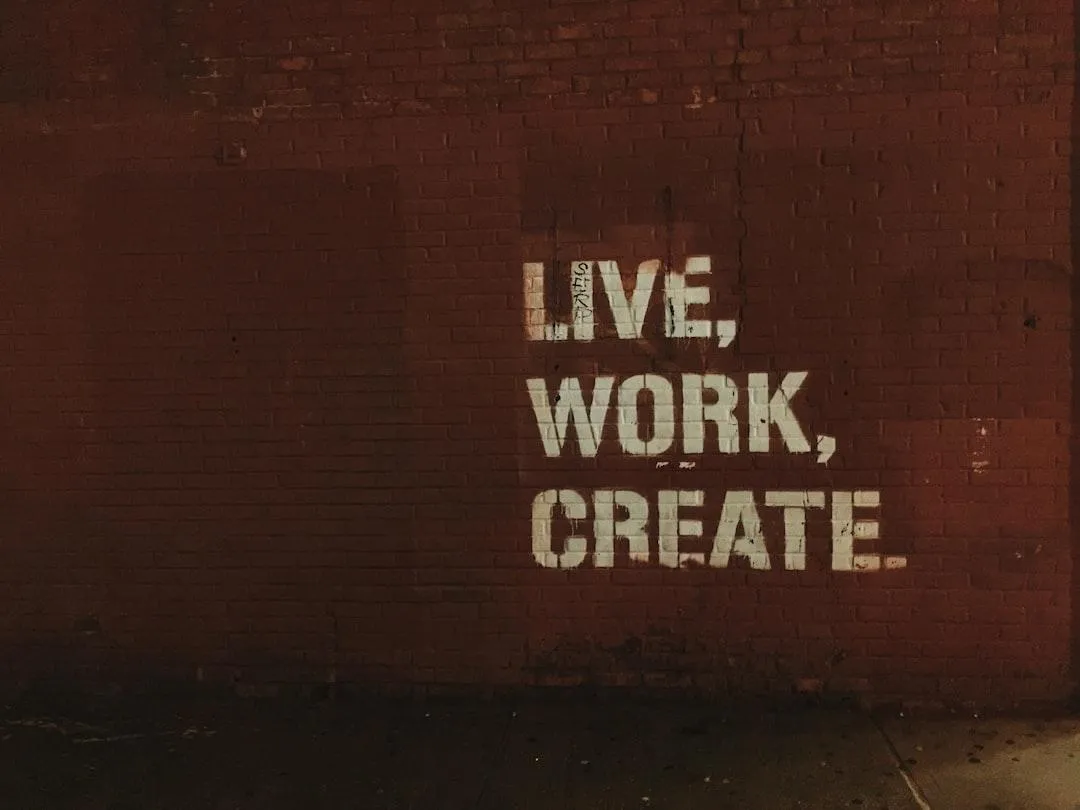
How to creatively design your week so it works for you (not against you)
If you have ever reached Friday afternoon feeling exhausted, vaguely behind, and quietly frustrated that once again the things that matter most to you personally did not make it onto your calendar, you are not alone.
Most of us were never taught how to design our weeks. We were taught how to respond to them. We open our inboxes and let the most urgent demands rise to the top. We fill our calendars with other people's priorities. We push our own creative work, thinking time, and personal projects to the margins -- to the mythical "when I have time" that somehow never arrives.
The result is a week that is technically productive but quietly draining. Full on paper, but flat in feeling.
What if there were another way? What if, instead of reacting to your week, you designed it -- deliberately, creatively, and with your own energy and priorities at the centre?
Why your current week might be working against you
The standard approach to weekly planning is, at its core, a system built around scarcity and obligation. You block time for what is already committed. You schedule around deadlines. You carve out whatever is left for everything else -- which is usually very little.
This approach has a fundamental flaw: it treats your time as something to be managed rather than something to be designed. And it consistently places your most important, most nourishing, most creatively alive work at the end of the queue.
Research on cognitive performance consistently shows that creative thinking, deep problem-solving, and the kind of expansive, generative thinking that leads to our best ideas and decisions are not things we do with leftover energy. They require our best hours, our freshest thinking, and a kind of protected space that reactive scheduling almost never provides.
When professional women tell me they have lost their creative spark, the most common culprit is not laziness, not lack of talent, and not a sudden disappearance of ideas. It is a week that was never designed to hold creativity in the first place.
The difference between a managed week and a designed week
A managed week is reactive. You start with what is already there -- your meetings, your deadlines, your obligations -- and fit everything else around the edges.
A designed week is intentional. You start with your values, your energy, and your priorities, and build your commitments around them.
In a managed week, your creative work is an afterthought. In a designed week, it is a foundation.
This does not mean abandoning your responsibilities or pretending that meetings and deadlines do not exist. It means making a conscious choice about what gets protected time -- and deciding, once and for all, that your creative thinking, your personal projects, and your inner life deserve to be on that list.
Understanding your creative energy
Before you can design a week that works for you, you need to understand something fundamental: not all hours are equal.
Most people have a natural rhythm of energy across the day. There are hours when your thinking is sharp and expansive -- when ideas come easily, connections emerge, and you can engage with complex or creative work without effort. And there are hours when your energy is lower, your thinking more plodding, and you are better suited to mechanical tasks, admin, or rest.
The trouble is that most of us have never audited our energy honestly. We schedule demanding creative work into the hours when our energy is already depleted, then wonder why the work feels so hard.
Here is a simple exercise. For the next three days, notice your energy levels at different points across the day. When do you feel most alive and alert? When does your thinking feel richest and most creative? When does your focus naturally flag? When do you feel most suited to routine tasks?
You may discover that you do your best creative thinking in the early morning before the demands of the day crowd in. Or late at night when the house is quiet. Or in that specific window between 10am and noon before your energy dips after lunch.
Whatever your pattern, that is your creative window. And it is the most valuable real estate in your week.
How to protect your creative window
Once you know when your creative energy peaks, the next step is to protect it. Not just in theory, but in practice.
This means blocking your creative window in your calendar before anything else gets scheduled. It means treating it with the same seriousness you would give a client meeting or a critical deadline. It means learning to say, gracefully but firmly, that you are not available during that time.
Many women resist this initially. It feels selfish. It feels indulgent. It feels as though protecting time for creative work means letting other things slide.
But consider the alternative. When you never protect time for the work that energises and sustains you, you eventually have nothing left to give to anyone or anything else. Depletion is not a productivity strategy.
Protecting your creative window is not a luxury. It is essential.
Designing your week: A simple framework
Rather than prescribing a rigid structure, here is a flexible framework you can adapt to your own life, work, and rhythms.
Start with energy, not time
Before you look at your calendar, ask yourself: when am I at my best? Map your natural energy peaks and troughs across a typical day and week. Some people find their sharpest thinking comes in the morning; others find their creative energy rises in the afternoon or evening. Neither is wrong. Design around reality, not aspiration.
Assign your hours intentionally
Once you know your energy pattern, match the type of work to the type of hour. Creative and generative work -- writing, making, designing, thinking, planning, problem-solving -- belongs in your peak hours. Administrative tasks, emails, routine decisions, and meetings belong in your lower-energy windows. Most people have this backwards, and they wonder why everything feels so hard.
Build in transition time
One of the most underrated elements of a well-designed week is the space between things. When one commitment runs directly into the next, your brain has no opportunity to integrate, reflect, or reset. Even ten to fifteen minutes between significant tasks can dramatically improve the quality of everything that follows.
Schedule creative work before it is ready
This is important: do not wait until you feel inspired, prepared, or "in the right headspace" to block time for creative work. Block it first. Inspiration, it turns out, tends to follow commitment rather than precede it. When you show up for your creative time consistently, even imperfectly, it begins to flow more readily.
Revisit your week on Sunday
Spend fifteen to twenty minutes at the end of each week reviewing what worked and what did not, and designing the week ahead with intention. This does not need to be a lengthy ritual -- a notebook, a quiet cup of tea, and fifteen minutes of honest reflection is enough. The practice of looking at your week before it begins, rather than only reacting as it unfolds, is one of the single most effective things you can do to protect your priorities.
Releasing the myth of perfect conditions
Here is something that creative women often need to hear: you do not need ideal conditions to begin.
You do not need a dedicated studio, a completely clear schedule, or a long uninterrupted afternoon. You do not need to feel inspired, rested, or perfectly prepared. You do not need to have resolved every obligation before you give yourself permission to create.
You need fifteen minutes and the willingness to start.
The myth of perfect conditions is one of the most effective ways the inner critic keeps creative women from showing up for their own work. It dresses itself up as sensibility -- "I will start when things settle down," "I will make time when this project is finished" -- but it is, at its heart, a form of self-abandonment.
A creatively designed week does not wait for perfect conditions. It creates imperfect conditions and begins anyway.
A week designed for you
Let's bring this together. A week that is designed for you rather than against you is one that begins with your energy and your priorities rather than your obligations. It protects your creative window as fiercely as your most important meeting. It assigns the right kind of work to the right kind of hour. It builds in transition, reflection, and space. It releases the myth of perfect conditions. And it makes room for the connection and community that sustain creative energy over time.
This is not a radical restructuring of your life. It does not require quitting your job, finding extra hours in the day, or waiting until circumstances are more favourable.
It requires a decision: to take your creative self seriously enough to plan for her, protect time for her, and refuse to leave her perpetually at the end of the queue.
Your next steps
If this post has resonated with you -- if you recognise the exhausted, creatively hungry woman who keeps pushing her own work to tomorrow -- then I have something specific for you.
The Creative Reset is a free five-day workshop designed for creative women who have lost their spark to overwhelm, busyness, and a week that was never built with them in mind.
It begins on Monday, 20 April -- just ahead of World Creativity and Innovation Day on Tuesday, 21 April -- and runs for five days entirely by email, in your own time, around your existing life.
Over five days, you will receive a daily video lesson and creative action prompt designed to help you understand why your creativity has stalled, create genuine space for it in your week, close the gap between inspiration and action, protect your creative energy, and build a sustainable rhythm you can actually maintain.
You will also receive all the practical tools to help you design a week that genuinely works for you. And you will have access to our private community, The Creative and Playful Life, where you can share the journey with other women doing exactly the same.
It is completely free. It is entirely flexible. Registration closes on Saturday, 18 April.
If you are ready to stop leaving your creativity at the end of the queue, I would love to have you join me on Monday 20 April.
Register for The Creative Reset